
A homeowner might ask an AI search tool, "Which landscaping companies near Hayden can help redesign a small backyard?" Another might ask what to compare before hiring a contractor in Spokane Valley.
For your business to be represented accurately, the information available about you needs to explain what you do, where you work, and what makes your experience relevant to that question.
For business owners in Kootenai and Spokane counties, a useful starting point is to review whether your website gives clear, specific answers. You can improve that information while building a stronger resource for people who visit your site.
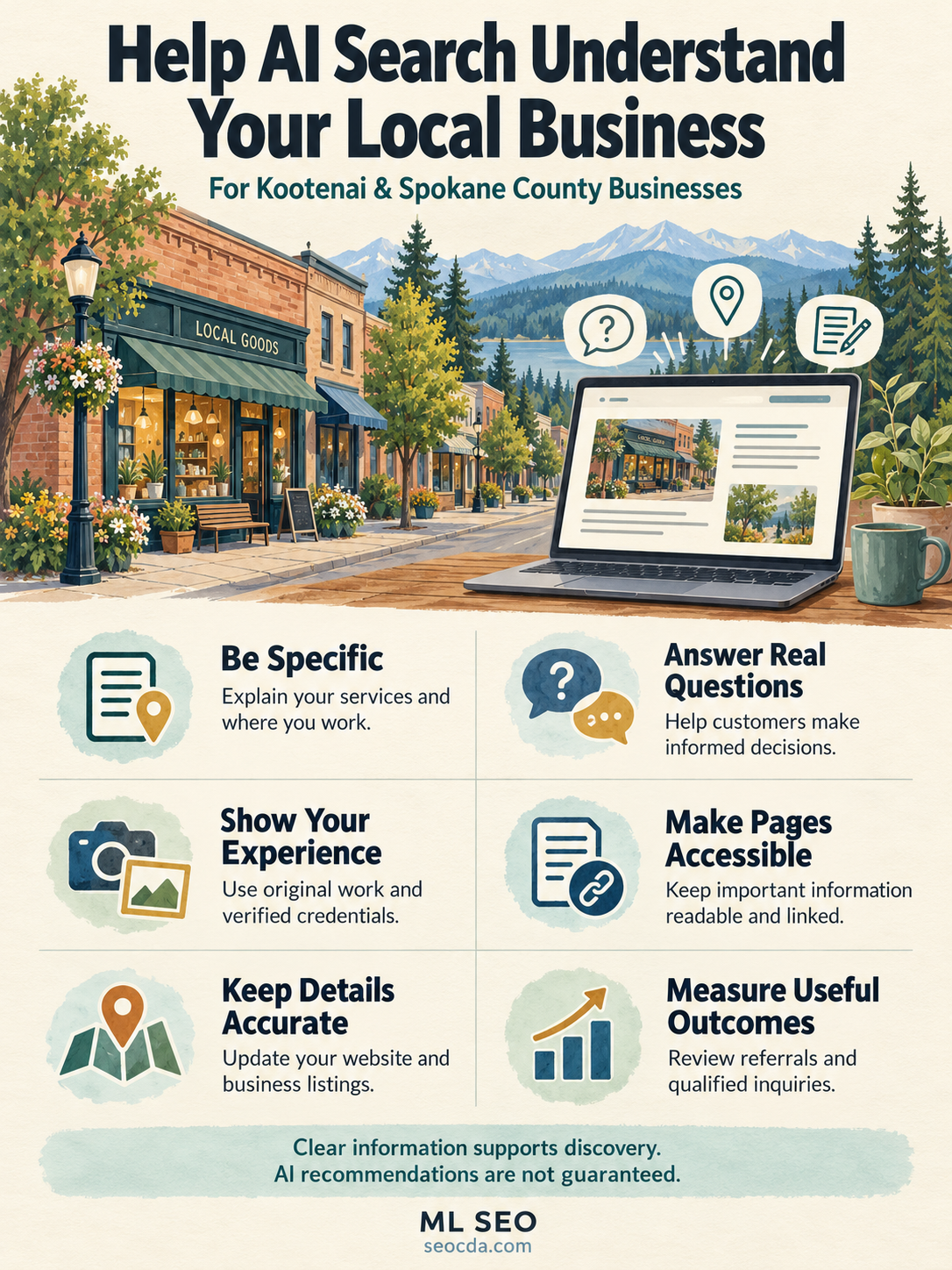
Decide what AI visibility means for your business
An AI search response might mention a company, link to a helpful article, or suggest businesses to investigate. Those are different outcomes. A citation to your website is an opportunity for someone to learn more; it does not necessarily mean the tool recommends hiring you.
Choose a practical goal before assessing results. You might want accurate descriptions of your services, visits to a relevant service page, or more qualified inquiries from a particular community.
For Google's AI Overviews and AI Mode, Google's guidance says established SEO practices remain relevant. A review of your website SEO is a useful place to begin.
Make your services and location easy to understand
Read your main service page as if you know nothing about your company. Can you identify the service, the customer it is suited to, where it is available, and how to request help?
Consider a hypothetical landscaping business based in Hayden. A description such as "complete outdoor solutions" leaves important questions unanswered. Specific information about landscape redesign, the kinds of projects accepted, the communities served, and the consultation process gives a potential customer much more to evaluate.
Keep the business name, contact information, location, and service details current across your website and important listings. Explain the difference between where you are based and where your team travels.
Our recommendation is to begin with the pages tied to the work you want more of. Improve those descriptions before expanding into new articles.
Answer the questions that come before an inquiry
Build content around the conversations you already have with prospective customers. What do they need to understand before they can make a useful decision?
For the hypothetical landscaper, helpful questions could include what affects project scope, what information to gather before requesting an estimate, how the design process works, and which types of projects the team handles.
Give a direct explanation, then add the details that help someone apply it. Use plain headings and connect each answer to the relevant service page.
Good on-page SEO and content planning can make those answers easier to navigate. We recommend treating FAQs as a way to resolve real customer uncertainty. A heading phrased as a question is useful only when the answer adds substance.
Show the experience behind your information
A service description becomes more useful when readers can understand who stands behind it. Introduce the people doing the work, explain relevant qualifications, and show the process customers can expect.
Where appropriate, include original project photographs, a clear explanation of the work performed, or a documented example of how a problem was resolved. Use only details you can verify and have permission to share.
Google's helpful content guidance encourages original information and clarity about who created the content.
Our recommendation is to use evidence that helps a customer judge your suitability. For a local contractor, that might be an explanation of a completed project and the decisions involved. For a professional service, it might be an accurate team biography and a clear explanation of the consultation process.
Check whether your important pages are accessible
Ask your website provider to review whether the service pages you want discovered are publicly accessible, readable, and linked from relevant parts of your site. Important explanations should appear as text, even when photographs or infographics also illustrate them.
Google says a page must be indexed and eligible for a search snippet to appear as a supporting link in AI Overviews or AI Mode. Meeting those conditions does not guarantee inclusion.
For ChatGPT search, OpenAI identifies OAI-SearchBot as its search crawler. OpenAI separates that access setting from GPTBot, which concerns content that may be used for model training. Your provider can review search access in line with your preferences about how your content is used.
A technical review should identify specific barriers on your site. Allowing access is an eligibility step, and it does not promise a recommendation.
Keep structured business information accurate
Structured data is a standardized way to label information on a web page. Google's LocalBusiness documentation describes using it to provide business details such as hours and contact information.
If your website includes this markup, have the person maintaining it check that it reflects the business accurately and agrees with the information visitors can read.
Google specifically says its AI search features do not require special AI files or special schema markup. Keep the focus on accurate information, useful content, and a website people can navigate.
Review answers and business outcomes together
For an initial visibility check, choose a small set of realistic customer questions. Record the exact question, named location, platform, date, and any sources linked in the response. Note whether the answer describes your company accurately.
We recommend using those checks to find information gaps and errors. A handful of prompts cannot establish a dependable ranking or tell you what every prospective customer sees.
Review available referral traffic in your website analytics alongside inquiries and booked work. Ask new customers how they first learned about the business, and keep that information with the lead record.
Google reports traffic from its AI search features within Search Console's overall Web performance data. An increase in total Google traffic alone does not establish how much came from an AI feature.
Choose one useful improvement to make first
Start with one service page and one recurring customer question. Check the business facts, improve the explanation, add relevant evidence, and make the next step easy to find. Record what you changed so you can evaluate it later.
ML SEO provides marketing support for Hayden businesses and digital marketing services in Spokane Valley, along with surrounding communities in Kootenai and Spokane counties.
If you want help reviewing how your website describes your business and supports discovery, contact ML SEO to discuss your website and content. We can review the pages supporting your priority services and discuss practical next steps.
Frequently Asked Questions about SEO
-
A citation identifies a source used in an answer. Read the surrounding response to see whether it supports a specific fact, points to an educational article, or actually suggests considering your business.
-
We recommend reviewing your important service pages first. Add articles when you can answer useful customer questions with original, accurate information. Choose topics that support your services and give readers something meaningful to act on.
-
OpenAI documents separate controls for OAI-SearchBot and GPTBot. Ask your website provider to review the current settings and guidance so that search access and training preferences are handled deliberately.
