
Your team regularly serves customers in the next town. Your website mentions that community, and you would welcome more work there. Then you search Google Maps and struggle to find your business.
For a hypothetical plumbing company based in Hayden, that might mean appearing near its own neighborhood while being harder to find in Coeur d'Alene. A contractor serving Spokane and Spokane Valley could face a similar question.
Understanding what changes between those searches can help you choose a useful next step for your marketing.
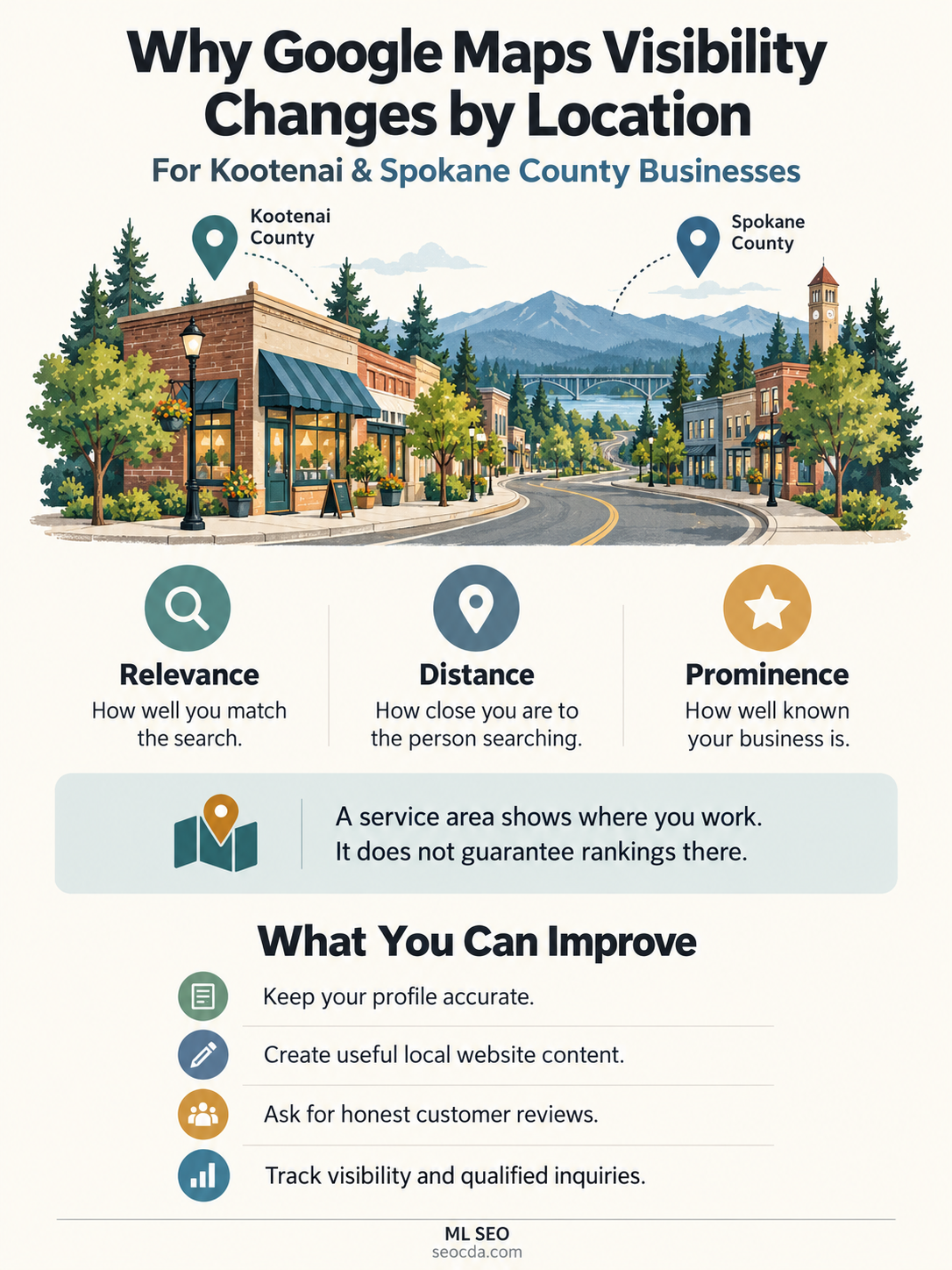
Why search location changes the results
Google's local ranking guidance identifies three main considerations: relevance, distance, and prominence. Relevance concerns how well a business matches the search. Distance concerns its location relative to the searcher. Prominence reflects how well known it is, with links and reviews among Google's examples.
That means a search from your office provides one view of your visibility. A prospective customer searching elsewhere may see a different set of businesses. The service being searched also matters, so record the exact phrase when you compare results.
What adding a service area actually tells customers
A service area on your Google Business Profile communicates where you provide service. For eligible businesses that travel to customers, it is an important part of describing how the business operates.
However, it is a mistake to treat that list as a promise of map placement throughout every selected city. Google's distance guidance still applies. Adding Spokane Valley to a service area does not establish a physical office there.
Keep coverage accurate. A company that visits customers and does not receive them at its business address should hide that address on its profile, following Google's service area guidance.
Check whether your profile matches the business you run
Before expanding your marketing, review the information customers already see. Is your category an accurate description of your core business? Are the phone number, website, hours, and services current? Would a new customer understand what you do and how to reach you?
Use your actual business name. Adding extra city names or service keywords solely for search visibility can violate Google's naming guidelines. Additional profiles also need to represent eligible business locations; a mailing address alone does not establish one.
These checks give your local SEO strategy a clear starting point. They also prevent a frustrating situation in which someone finds your business but reaches outdated information.
Give nearby customers useful information on your website
A website page should help someone decide whether your business can solve their problem. A long list of cities rarely answers the questions that come before a phone call.
Consider a hypothetical electrician serving Hayden and Coeur d'Alene. Useful content could explain the residential services available, how to request a visit, what information to have ready, and which communities the team actually serves. Real project examples can add detail when you have permission to share them.
Our recommendation is to create a separate location page when you can give readers meaningful information about service in that community. Replacing one city name with another throughout otherwise identical pages adds little value. Google specifically warns about doorway pages created around similar regional searches that funnel visitors elsewhere.
This is where on-page SEO and content optimization can help organize useful service information, headings, and links. Treat the website as another way for customers to discover and evaluate you, while measuring its organic results separately from map placement.
Make genuine customer feedback part of the process
Ask customers for honest feedback after a completed service, and make the review link easy to use. Reply thoughtfully when someone shares their experience or raises a concern.
Google prohibits offering incentives in exchange for reviews. Keep requests neutral and grounded in real customer experiences.
From a customer's perspective, specific feedback can answer practical questions about communication, professionalism, and the service experience. Give people space to describe those details in their own words.
Measure visibility across the places you want to serve
For a business serving several communities, we recommend tracking a small set of important service searches from consistent locations. A map grid report can sample the same query across several points and show where your business was observed at that time.
Keep the search phrases, grid points, and report settings consistent when comparing periods. Treat the report as a sample of visibility, with the date and settings attached. It cannot reproduce every customer's search.
Then connect that information with inquiries. Record which communities new callers come from and which services they request. Google Business Profile performance can show website clicks and call-button clicks, but a call-button click does not establish that a conversation or booking happened. If you advertise, note that Google's profile performance data can include activity from Google Ads.
A useful monthly review combines those observations: where you appeared, how people interacted, and which inquiries became work.
Choose the next improvement around a business goal
Start with the community and service that matter most to your business. A plumber seeking more repair work in Coeur d'Alene may need a different content plan from a specialty retailer trying to attract visitors to a Spokane Valley storefront.
Review the profile details, the relevant website page, recent customer feedback, and a consistent visibility report together. Decide which gap you can address, record the change, and use the next review to assess progress.
That approach gives each improvement a purpose. It also keeps your marketing focused on the customers you have the capacity and desire to serve.
Build a local plan for your service area
ML SEO works with business owners seeking local marketing support in Coeur d'Alene and digital marketing in Spokane Valley, along with surrounding communities in Kootenai and Spokane counties.
If you are unsure where your business appears or which improvement should come first, contact ML SEO to discuss your local visibility. We can start with the services and communities you want to reach and discuss a practical direction for your website and Google Business Profile.
Frequently Asked Questions about SEO
-
It should accurately describe where you work. It does not guarantee placement throughout those communities. Use the field to communicate genuine coverage, then assess visibility with consistent searches.
-
We recommend a separate page when you can provide useful information for customers in that community. Start with clear service pages and accurate coverage, then add location pages where they serve a real reader need.
-
For ongoing planning, a monthly review is a useful starting point. Keep the same search phrases and locations, record changes you make, and compare visibility with qualified inquiries over several reporting periods.
